Golfer's Elbow and Lower Back Pain: Physiotherapy for Mallorca's Golf Community
Mallorca has become one of the most popular golf destinations in Europe, with dozens of courses spread across the island attracting both residents and visiting players year round. With so many rounds being played in near constant sunshine, it is no surprise that golfer's elbow and lower back pain rank among the most common complaints we treat at The Movement Mallorca. Both conditions share a similar root cause, and both respond extremely well to the right kind of physiotherapy.
Unlike a sudden injury from a fall or collision, golf related pain almost always builds gradually from repeated swings performed with the same mechanical pattern round after round. This makes it easy to ignore in the early stages, right up until the discomfort starts affecting your swing or your ability to walk eighteen holes comfortably. This article explains why golfer's elbow and lower back pain are so closely linked, what causes them, and how targeted treatment gets golfers back to their normal game.
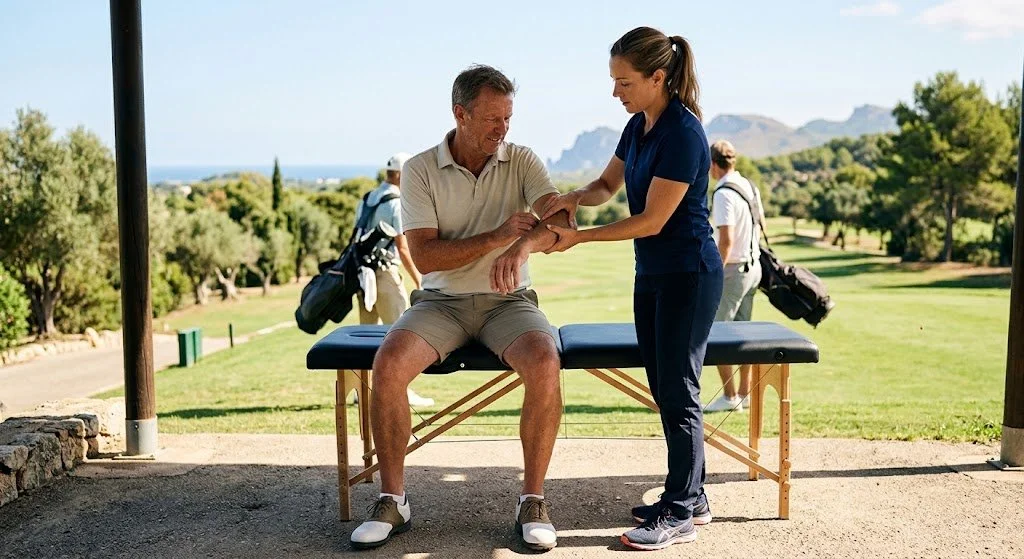
Golfer's Elbow and Lower Back Pain in Mallorca's Active Golf Community
Golfer's elbow refers to irritation of the tendons on the inner side of the elbow, usually from the repetitive wrist flexion and forearm rotation involved in the golf swing. Lower back pain in golfers typically stems from the significant rotational force generated through the spine during the downswing, especially when that rotation is not well supported by hip and core mobility.
The two conditions frequently appear together because a restricted lower back often forces the arms and wrists to compensate during the swing, increasing strain through the elbow. Golfers who play multiple rounds a week, which is common given the island's mild climate, rarely give these tissues enough recovery time between sessions, allowing small amounts of irritation to build into a persistent problem.
What Causes These Injuries in Golfers?
Poor swing mechanics are the single biggest contributor to both golfer's elbow and lower back pain. A swing that relies too heavily on the arms rather than rotating through the hips and torso places excessive load on the elbow tendons with every shot, while a similar pattern forces the lower back to absorb rotational force it was never designed to handle alone.
Limited hip and thoracic spine mobility compounds the problem significantly. When the hips cannot rotate freely, the lower back has to make up the difference during the downswing, and that extra rotation accumulates into strain over the course of a season. The same restriction often shows up in the follow through, adding further stress to the lead side of the back.
Sudden increases in playing frequency, particularly among visitors who play daily during a golf focused holiday, do not give the body time to adapt to a new level of load. Equipment factors matter as well, since clubs that are too stiff or improperly fitted for a player's swing speed transmit more shock through the arm on impact.
Physiotherapy for the Golf Swing and Overuse Injuries
Effective treatment for golf related injuries has to consider the swing itself, not just the painful joint in isolation. Our approach through sports physio in Mallorca looks at hip rotation, thoracic mobility, and grip mechanics together, since improving movement in one area often reduces strain significantly in another without needing to change the swing dramatically.
We also draw on the same principles used for other racket and overuse sports, since the loading pattern that causes golfer's elbow shares real similarities with what we see in our guide to tennis and padel elbow treatment . Both conditions respond to a progressive tendon loading programme rather than complete rest alone.
Treatment Options at The Movement Mallorca
Assessment begins by identifying whether the elbow pain stems purely from tendon overload or whether restricted mobility elsewhere in the body is forcing the arm to compensate. Our physiotherapy treatments combine manual therapy to release tension in the forearm and shoulder with a structured strengthening programme that rebuilds tendon capacity over several weeks.
For lower back pain, treatment focuses heavily on restoring hip and thoracic rotation, since this takes direct pressure off the lumbar spine during the swing. Our detailed guidance on osteopathy for back pain relief outlines a complementary approach many golfers find valuable alongside physiotherapy, particularly when stiffness rather than instability is the main driver of their discomfort.
Golfers dealing with more persistent or recurring back pain sometimes benefit from a broader movement assessment. Our page on back motion physiotherapy in Mallorca covers how restoring healthy movement patterns through the spine reduces the likelihood of pain returning once you resume regular play.
Preventing Golfer's Elbow and Back Pain Before They Start
Building rotational mobility through the hips and upper back should be part of every golfer's regular routine, not just something addressed after pain appears. A few minutes of targeted mobility work before each round, combined with a consistent strength routine during the week, keeps the tissues that absorb rotational load resilient enough to handle regular play. Our page on mobility exercises to reduce pain and stay active offers a practical starting point.
Reviewing swing mechanics with a coach or physiotherapist can catch compensation patterns before they turn into injuries. A swing that looks fine on video but relies too heavily on the arms or forces excessive spinal rotation is often invisible to the player until pain forces a closer look.
Pacing playing frequency matters just as much for regular residents as for visiting golfers on a dedicated golf holiday. Giving the body at least one or two rest days between rounds, particularly during periods of increased play, allows tendons and the lower back time to recover rather than accumulating strain round after round.
When to See a Physiotherapist?
Elbow pain that persists beyond two weeks, or back pain that limits your rotation during the swing, are both clear signs that a proper assessment will get you back to full play faster than waiting it out. Ignoring early symptoms tends to push golfers into a cycle of playing through discomfort, which only extends the eventual recovery timeline.
If back pain has become a recurring issue that flares up after nearly every round, it is worth investigating further with imaging in some cases. Our overview on MRI scans for low back pain explains when this kind of investigation is genuinely useful and when a clinical assessment alone provides enough information to start effective treatment.
Final Thoughts
Golfer's elbow and lower back pain are two of the most common complaints among Mallorca's active golf community, and both are closely tied to swing mechanics, mobility restrictions, and playing volume rather than bad luck. With the right assessment and a treatment plan that addresses the whole kinetic chain rather than just the painful area, most golfers return to their normal game without needing to change their swing dramatically.
Frequently Asked Questions
What is the difference between golfer's elbow and tennis elbow?
Golfer's elbow affects the tendons on the inner side of the elbow, while tennis elbow affects the outer side. Both are forms of tendon overload from repetitive movement.
Why does lower back pain happen so often in golfers?
The golf swing generates significant rotational force through the spine, and limited hip or thoracic mobility often forces the lower back to absorb more of that rotation than it should.
Can I keep playing golf with golfer's elbow?
Playing through worsening pain usually delays recovery. A modified schedule with reduced swing volume, guided by a physiotherapist, allows most golfers to stay active while healing.
How long does golfer's elbow take to heal?
Mild cases often improve within four to six weeks with proper treatment, while more established cases can take two to three months of structured rehabilitation.
Does improving hip mobility really help with golf related back pain?
Yes. Better hip rotation reduces the amount of twisting force the lower back has to absorb during the swing, which is one of the most effective ways to prevent recurring back pain in golfers.