
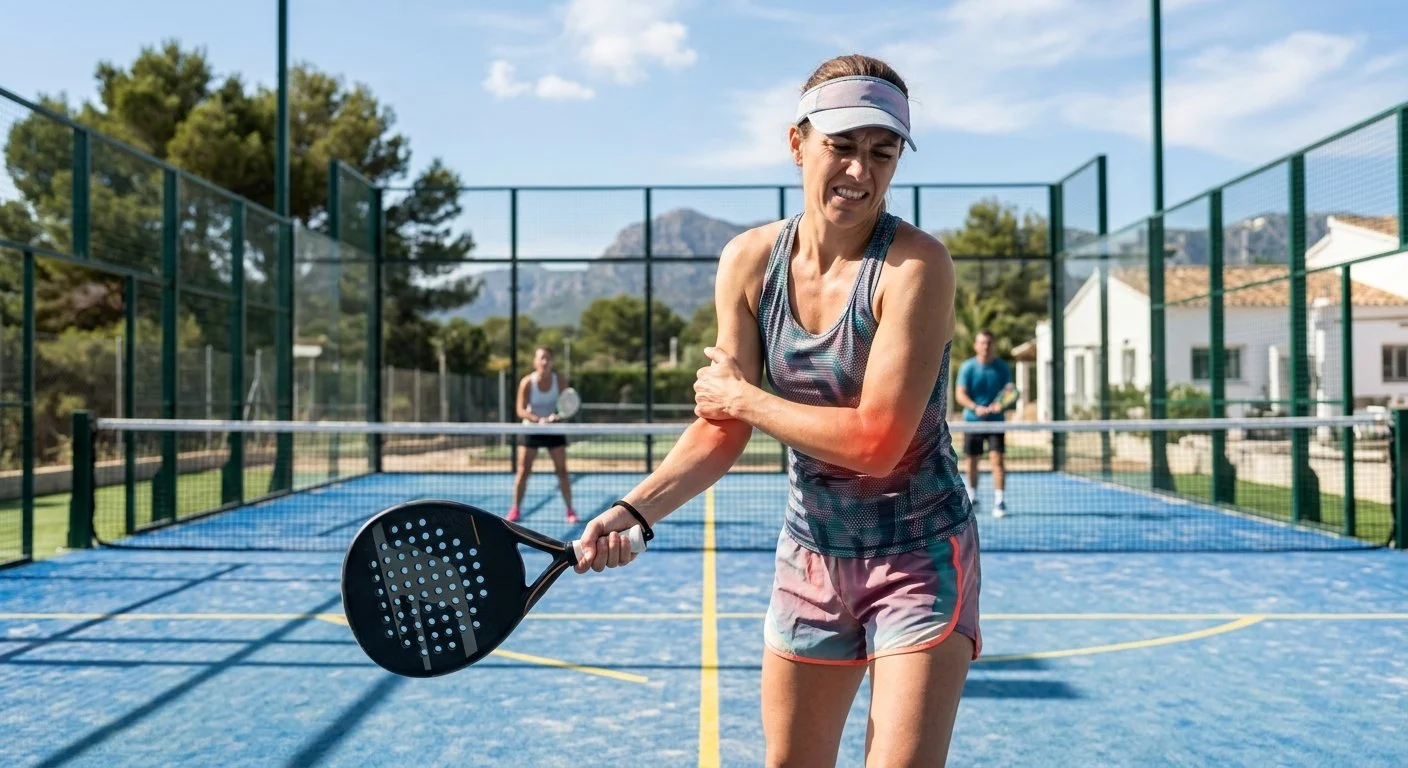
Padel & Tennis Elbow: Why It's So Common Among Mallorca's Expat Community
If you have moved to Mallorca and picked up a racket for the first time in years, you are not alone. Padel clubs are opening across the island, and tennis courts stay booked from early morning until sunset. Many newcomers play far more often here than they ever did back home, and their elbows are starting to notice. At The Movement Mallorca, our physiotherapists see this pattern constantly among the expat community: enthusiastic players who go from once a month to three or four sessions a week within a few short months of arriving.

That sudden jump in activity, combined with unfamiliar court surfaces and equipment, is exactly the recipe that leads to tendon overload. The result is a nagging pain on the outside or inside of the elbow that does not go away with rest alone. This article explains why padel and tennis elbow show up so often among people who have relocated to the island, what is actually happening inside the joint, and how proper treatment gets you back on court without dragging the problem out for months.
Why Padel and Tennis Elbow Is So Common in Mallorca
Padel and tennis elbow are both forms of tendinopathy, meaning the tendons attaching to the bony bump on either side of the elbow become irritated from repeated stress. Tennis elbow affects the outer tendon and is linked to the backhand and the wrist extensor muscles. Golfer's elbow, on the inner side, tends to show up with heavy forehand or serve loading. Padel players get a version of both, since the shorter court and enclosed walls encourage quick, repeated wrist snaps that a tennis swing does not always require.
Mallorca's expat lifestyle adds several layers on top of the biomechanics. Many people arrive with more free time than they had in their previous city, so they throw themselves into a new sport enthusiastically. Others switch from a gym routine to racket sports and skip the conditioning work their forearms actually need. Add in warm weather that lets people play year-round with no off-season for the tendon to recover, and it becomes clear why clinics across the island report a steady rise in elbow complaints among newer residents.
Physiotherapy for Expats in Mallorca Dealing With Elbow Pain
Being new to an area often means starting from zero with healthcare providers, and that includes not knowing where to turn when a sports injury flares up. Many expats try to push through the discomfort because they are unsure of the local system or simply assume it will settle on its own. Unfortunately, tendon problems rarely resolve without the right kind of load management and hands-on treatment, and delaying care usually means a longer recovery later.
Our team includes German, English, Italian, and Spanish-speaking practitioners, which removes one of the biggest barriers expats face when seeking care abroad. If you are looking for support in your own language, our page on physiotherapy for German expats in Mallorca explains how we bridge that gap for the island's large German-speaking community, and the same approach applies across our multilingual clinic for every nationality we treat.
What Causes Padel and Tennis Elbow?
The underlying cause is almost always repetitive strain rather than a single traumatic event. Every time you hit a ball, the tendon fibres experience a small amount of stress. Under normal circumstances, the tissue repairs itself between sessions and comes back slightly stronger. Problems begin when the volume or intensity of play outpaces that repair process, and microscopic damage starts to accumulate faster than the body can fix it.
Equipment plays a bigger role than most players realise. A racket that is too stiff, strings that are too tight, or a grip size that does not match your hand all increase the load transmitted through the forearm on contact. Technique matters just as much. Leading with the elbow instead of rotating through the shoulder and torso puts far more strain on the tendon with every single shot.
Court surface and playing frequency round out the picture. Padel's glass walls send the ball back into play more often than tennis, meaning more total shots per match. Combine several matches a week with poor warm-up habits and minimal forearm conditioning, and the tendon simply never gets the recovery window it needs.
Recognizing the Symptoms Early
Most people describe the early stage as a dull ache on the outside of the elbow that appears after playing and fades within a day. This is the point where a short adjustment in training load and some targeted exercises can prevent things from getting worse. Left unaddressed, the pain typically progresses to a sharper sensation during the swing itself, followed by weakness when gripping everyday objects like a coffee cup or a door handle.
A useful warning sign is pain that lingers into the following morning rather than settling overnight. Another is discomfort that spreads from the elbow down into the forearm during activities that have nothing to do with sport, such as opening a jar or shaking hands. Once symptoms reach that stage, self-management with rest and ice rarely resolves things on its own, and a proper assessment becomes the faster route back to pain-free play.
Treatment Options at The Movement Mallorca
Effective treatment starts with an accurate diagnosis, since elbow pain can sometimes mimic nerve irritation from the neck or shoulder rather than a true tendon problem. Our physiotherapy treatments in Mallorca begin with a thorough assessment of your swing mechanics, grip strength, and the specific movements that reproduce your pain, so the plan we build actually addresses the root cause rather than just the symptom.
From there, treatment usually combines manual therapy to reduce tension in the forearm muscles with a progressive loading programme for the tendon itself. Research consistently shows that gradually reintroducing controlled strain, rather than complete rest, is what rebuilds tendon resilience. We also look at the kinetic chain above the elbow, since a stiff shoulder or weak rotator cuff often forces the forearm to absorb load it was never designed to handle.
For players eager to return to competitive matches, we build a phased plan that reintroduces hitting volume step by step, checking that pain stays within acceptable limits at each stage. This structured approach for sports physio in Mallorca is what separates a lasting recovery from a cycle of flare-ups that keep bringing players back to the clinic every few months.
The Role of Sports Massage and Mobility Work
Sports massage plays a genuinely useful supporting role in elbow rehabilitation. Releasing tightness in the forearm flexors and extensors reduces the pulling force on the irritated tendon and can noticeably ease day-to-day discomfort between physiotherapy sessions. Our guide to the benefits of sports massage in Mallorca covers how this fits alongside active rehabilitation rather than replacing it.
Mobility through the shoulder and wrist is just as important as strength in the forearm itself. Restricted shoulder rotation forces players to compensate with more elbow and wrist movement during every stroke, which quietly increases tendon load over the course of a season. Working through a routine of mobility exercises to reduce pain and improve movement alongside your rehab plan helps distribute effort more evenly across the joints and takes pressure off the healing tendon.
Preventing Padel and Tennis Elbow as an Active Expat
Prevention comes down to a handful of habits that are easy to overlook when you are excited about a new sport in a new country. Warming up the forearm specifically, rather than just jogging a lap around the court, prepares the tendon for the sudden loading that comes with the first few rallies. A few minutes of light wrist rotations and gentle stretching before play makes a measurable difference over time.
Grip size and string tension deserve a proper check rather than a guess. Many sports shops on the island can measure your hand and recommend the right grip, and a slightly looser string tension reduces the shock transmitted through the arm on impact. It is a small adjustment that pays off across dozens of matches.
Building forearm and shoulder strength outside of match play is the piece most recreational players skip entirely. Simple resistance work with a light dumbbell or resistance band, done two or three times a week, conditions the tendon to handle the demands of regular play far better than match practice alone ever will. Pacing your weekly volume, especially in the first few months of a new routine in Mallorca's favourable climate, protects you from the overload pattern that brings so many new residents into our clinic.
When to See a Specialist
Persistent pain that lasts more than two weeks despite rest, or pain that affects your grip strength during everyday tasks, is a clear signal to book an assessment rather than wait it out. Waiting longer often means the tendon has moved from an early inflammatory stage into a more chronic condition that takes considerably longer to resolve.
Our sports injury treatment in Mallorca covers the full picture of racket sport injuries beyond just the elbow, since problems in the shoulder, wrist, or even the lower back can all contribute to how load travels through the arm during a swing. Getting the full chain checked gives you a clearer answer than focusing on the painful spot alone.
Final Thoughts
Padel and tennis elbow are among the most common complaints we see among expats settling into life on the island, largely because the combination of enthusiasm, warm weather, and unfamiliar equipment creates the perfect conditions for tendon overload. The good news is that with the right assessment, a structured loading programme, and a few sensible adjustments to equipment and warm-up habits, most players return to full training within a matter of weeks rather than months.
Frequently Asked Questions
What is the difference between padel elbow and tennis elbow?
Both involve irritation of the tendons around the elbow, but padel elbow often affects both the inner and outer tendons due to the sport's shorter, faster wrist movements, while classic tennis elbow is usually limited to the outer tendon from backhand strokes.
How long does it take to recover from padel and tennis elbow?
Mild cases often improve within four to six weeks with proper load management and physiotherapy, while more established cases can take two to three months of structured rehabilitation to fully resolve.
Can I keep playing padel or tennis with elbow pain?
Playing through sharp or worsening pain usually delays recovery. A physiotherapist can advise on a modified schedule that keeps you active while giving the tendon room to heal.
Do braces or straps actually help with tennis elbow?
A counterforce brace can reduce strain during the early painful stage and ease symptoms during activity, but it works best alongside a proper rehabilitation programme rather than as a stand alone fix.
Is padel harder on the elbow than tennis?
Padel typically involves more total shots per match because the ball stays in play longer off the walls, which can increase cumulative tendon load compared with a similar length tennis session.